Published May 2025
Brisbane was once seen as a second-tier city and ranked after Sydney and Melbourne; however, due to its semi-tropical climate and favourable location, it has transformed itself into a major city with its own unique identity and character.
To attract second-tier cities, the International Olympic Committee allowed bids for future Olympics that did not commit to new sporting infrastructure. The Palaszczuk government saw a successful Olympics bid as a way of signalling Brisbane’s arrival on the world stage while simultaneously charging Queensland’s economy.
That infrastructure commitment became a burden after it was realised the Gabba would not be fit for purpose as an Olympic stadium. Somehow it had not been factored that it was nearing the end of its life as a sports venue, needing to be replaced in due course and thus any monies spent on its refurbishment or expansion wasted.
A year of studying options on the Gabba’s site proved that to be the case, and to find an answer Graham Quirk was commissioned to review other locations, concluding Victoria Park was a good choice to accommodate a new stadium. However, in what appeared to be a move to comply with its Games commitment, the government was persuaded to choose the former Commonwealth Games stadium at QSAC at Nathan – an outlying, poorly accessible suburb – that would supply no tangible legacy to Brisbane.
This could have been the opportunity to properly consider Brisbane’s future and revisit some good master planning that had already been commissioned by the state government.
Instead, we saw a host of speculative schemes including Brisbane Bold (that placed all the major Olympic venues inside Victoria Park) plus others for Hamilton North, the Gabba and even Mt Coot-Tha.
The accompanying seductive images for Victoria Park were grabbed by the media and promoted as if it was a real proposal, creating a political controversy: “Hands off Victoria Park”!
Brisbane is distinguished by its unique place formed by its landscape – its dominant hill scapes, its river and streams and its cliffs – rather than by a particular building or set of buildings. To enjoy and appreciate Brisbane is to experience moving through its connections and pathways. Buildings and venues should be considered, especially how they fit together into a greater whole.
With time running out and a new state government came the opportunity to start again. A new 100-day study recommended what the Quirk study had earlier found – an athletics stadium placed in Victoria Park. But this time there were sensible reasons.
Victoria Park is an important part of the green space of the city, yet not highly used, as its connections with the city have never been fully explored: its edges are not activated and its main recreational use appears to be the mini golf course and driving range. To see it used and enjoyed more, its connections with the city need to be improved.
The opposition to Victoria Park appears to be emanating from those influenced by the earlier Archipelago scheme. Victoria Park has 64 hectares of open space, and the preferred stadium location is in the northeastern corner absorbing between 12 – 14 per cent of the park, leaving 56 hectares of park.
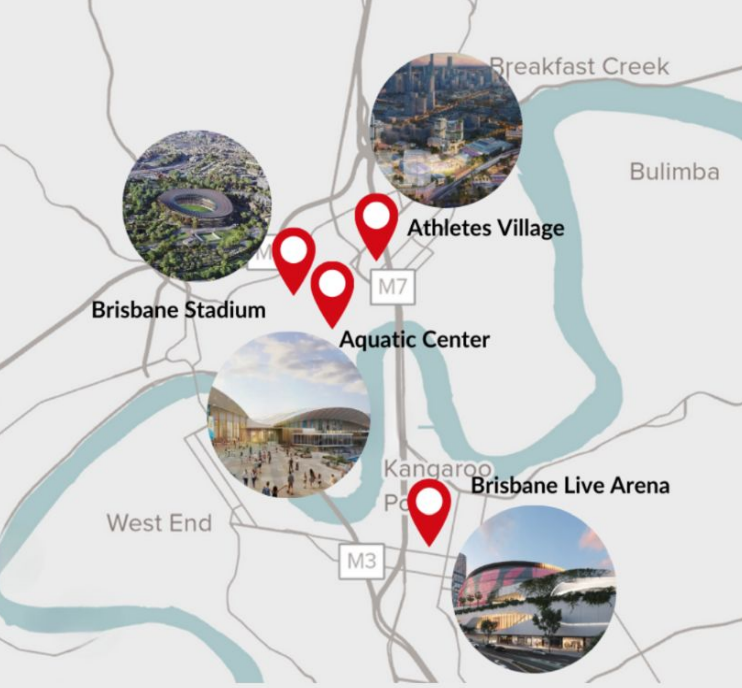
The stadium site connects with public transport through the Exhibition rail station and three Metro Stations – Herston, Kelvin Grove plus the hospital.
It connects with the Ekka too, utilising the Showgrounds for events, as well as the Royal International Convention Centre and Old Queensland Museum. In the future, the AFL, cricket as well as the public will benefit from these connections along with the proximity of swimming, rugby union and soccer venues. The proposed revitalisation of the remaining 56 hectares of Victoria Park will improve the park experience further, which will in turn catalyse urban renewal through attracting visitors as well as users.
The importance of these connections cannot be overstated. If done well, they will provide a series of linkages from which Brisbane may confidently grow. The games infrastructure commitment has unintentionally given us the opportunity to interconnect the significant green spaces in Victoria Park with sporting, entertainment activities and public transport links that will promote urban renewal precincts around the RNA, Bowen Hills, Newstead, Herston and Albion.
Let us not miss this opportunity by focussing just on a sporting venue, but rather on how the venue itself fits into Brisbane’s greater whole.
By doing so the Olympic Games will truly deliver a legacy for Brisbane.