In the aftermath of war, who do we blame? Who do we mourn? Who gets to decide?
The retelling of the ancient Greek tragedy of Antigone at La Boite reminded us of the importance of questioning power, at all costs.
Sophocles’ play follows sisters Antigone and Ismene as they decide what to do after their brothers Eteocles and Polynices die fighting against each other in a civil war for the Theban throne.
After the war, their uncle Creon takes the throne, and bans anyone from giving Polynices a proper burial, while Eteocles is given full honours.
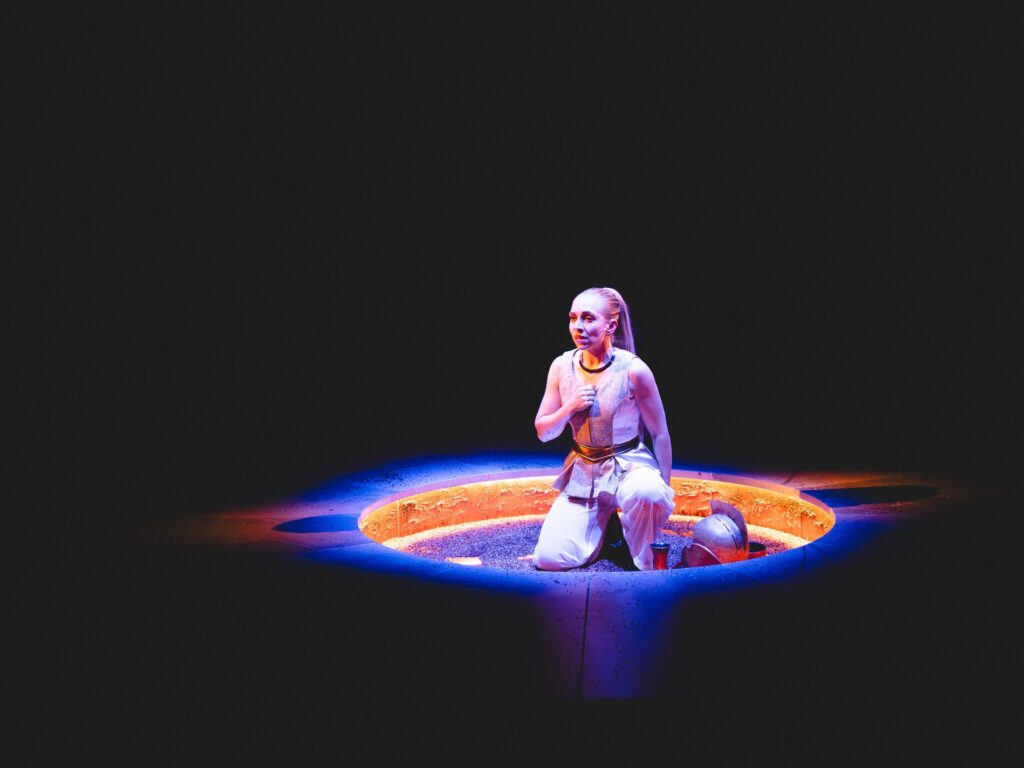
Maddison Burridge played Antigone the steadfast sister with conviction and confidence, as she defies Creon and her timid sister to conduct the burial rites for Polynices.
Creon’s stubborn refusal in defiance of the laws of the gods to listen to his son Haimon, who is engaged to Antigone, or the prophet Teiresias, and insistence on putting her to death for her rebellion has fatal consequences.
This sombre foreboding was cleverly signalled through set design by Josh McIntosh, who used the theatre’s roundhouse staging to maximum effect by placing a shallow hole in the middle of the circular stage.
Each death saw the characters step into this hole, symbolic perhaps of the Greek underworld or afterlife.
Sand fell in a stream from above, giving us the distinct impression of a sand timer, and time was running out.
Slight moments of humour strewn through the mostly serious play added to the depth – a well-timed pause for comic effect, a slight grin at a perceived double entendre – as in cooking, add a pinch of sugar to accentuate the savoury.
Billy Fogarty impressively played several roles: the cautious sister, passionate fiancée, timid guard, and portentous seer, bringing something different to each. They seamlessly switched between characters.
This casting choice helped to reinforce their roles as foils to the main characters and entrench the conflict between Creon and Antigone.
Having Hayden Spencer, with his towering stature and booming voice, play only the domineering Creon had the effect of cementing the character as the symbol of patriarchy.
The play certainly revealed how much and how little has changed in our world since Sophocles wrote it over 2000 years ago.
Creon’s decree that Antigone “never learned to yield” and has more yet to learn echoed into our own era… I wonder if Creon would have called Antigone “difficult” if asked to describe her in one word.
However, the feminist repositioning near the end felt like a school assignment, taking us out of the story, as the now ghostly Antigone stepped out of herself and turned into a narrator, drawing sweeping parallels between her actions and those of modern and historical figures such as Malala Yousafzai, Harriet Tubman, and Marsha P. Johnson.
While all incredible women, it seemed like the production was not giving the audience enough credit.
We could recognise these modern resonances ourselves. Show, don’t tell?
But aside from this production’s heavy-handed treatment of the theme, Antigone remains a glowing example of a strong woman who refused to sacrifice her faith and family for anyone.
That is where the most interesting part of the play lies for me – not just in that Antigone was a strong woman, but that she asked knotty questions of her society that we still struggle to answer today, as we face our own times of war.
What do we owe our fellow humans? We must be able to live with our consciences if the governments and leaders we elect do not uphold respect to all.
Antigone runs until March 21, get your tickets at laboite.com.au/shows/antigone.