Published April 2025
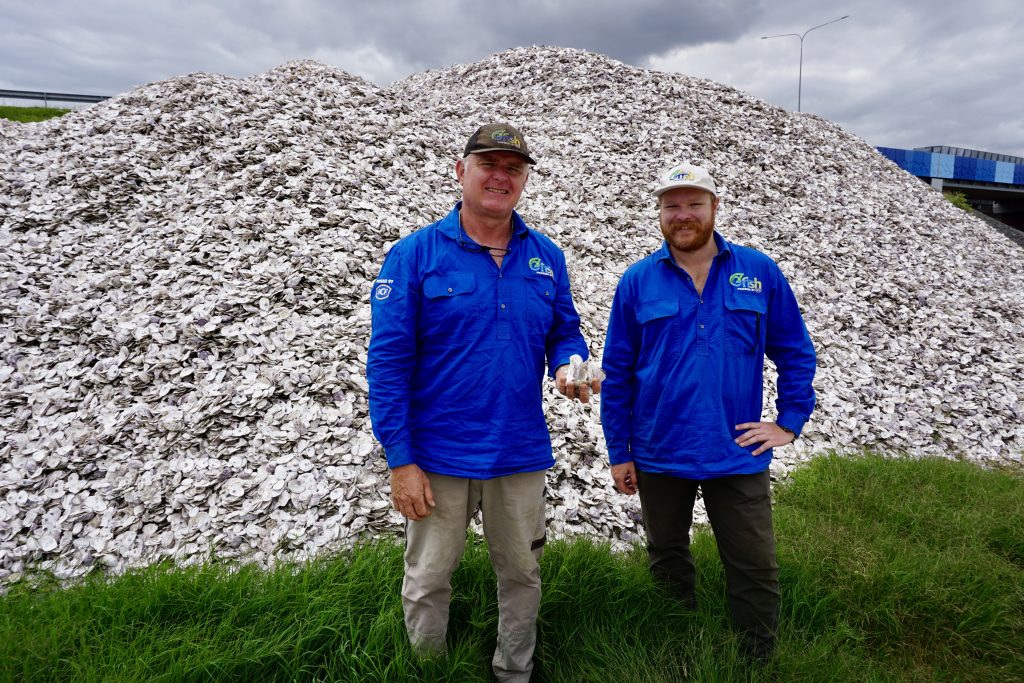
Many diners in Brisbane’s riverfront restaurants slurping on oysters wouldn’t think twice about their discarded shells, but for Wynnum’s Robbie Porter, they’re a valuable resource.
Mr Porter said: “Every old oyster shell can house up to ten baby oysters, which together can form a shellfish reef and help restore Moreton Bay.”
Once old oysters die, their shells attract baby oysters (spat) to grow on them, which forms a dense reef over time.
Shellfish reefs are also made up of oysters, mussels and other shellfish, and important for providing food and shelter for marine animals and filtering water.
Mr Porter said: “If we didn’t restore the [shellfish] reefs in Moreton Bay, we’d continue to have really low fish numbers, poor water quality, big algal blooms and very low biodiversity. What would happen is what’s happening right now – an unhealthy bay.”
Early Brisbane settlers used oyster shells in the mortar that goes between the sandstone blocks that made our city, he explained.
Before settlement, the river had “gin-clear” water, but the bay now has issues with sediment and turbidity due to the construction of dirt roads, land clearing and dredging.
Mr Porter said these changes have led to the loss of ninety-six per cent of shellfish reefs in Moreton Bay.
“When you consider that every hectare can make up to sixteen tonnes of fish every year forever, we’ve lost a huge resource,” he said.
Mr Porter joined environmental not-for-profit Ozfish and worked with volunteers to develop triangular-prism-shaped containers called Robust Oyster Baskets (ROBs), which hold waste oyster shells, with the aim of eventually rebuilding Moreton Bay’s shellfish reefs.
These ROBs were inspired by First Nations elder, Kabi Kabi man Uncle Fred Palin, who suggested they mirror the pyramid shape of a traditional oyster farming technique.
Australian First Nations people traditionally farmed oysters by tying cypress logs together, and it is believed that this technique was adopted by Chinese people as well, who built pyramids of sticks to grow oysters.
The oysters that grow on these logs are easy to remove.
Mr Porter said Uncle Palin’s suggestion was “like a lightbulb”.
“They work so well… We’ve got over fourteen thousand ROBs now in Moreton Bay. We’ve scaled up to become quite industrial. [The volunteers] can make well over two hundred of these baskets in a morning,” Mr Porter said.
The volunteers collect waste shells from restaurants, commercial oyster shuckers, and places like Eat Street Markets and Howard Smith Wharves.
Mr Porter said: “It’s been great for us, and they get rid of something they couldn’t otherwise compost.”
The oyster shells are then sterilised in the sun at Ozfish’s site at the Port of Brisbane for a minimum of four months.
They could still do with more volunteers.
“We really need your help… we’re very inclusive, we encourage people with special needs to join,” Mr Porter said.
If you would like to get involved, head to Ozfish’s website: https://ozfish.org.au/projects/moreton-bay-shellfish-reef-restoration/