What if John Keats was homeless on Brunswick Street? What if the cat across the street got lifted into space while I was checking the mailbox?
In each of these questions lies a kernel of real life, and a good dose of imagination, too.
What it would be like for Keats in love in modern-day Brisbane is the question Trent Dalton and his wife Fiona are asking as they work on a screenplay with Australian film director and screenwriter PJ Hogan, hunkered down in a writer’s room in New Farm.
“A guy like that is that passionate about poetry and words, he would have no compromises, and he would likely be homeless,” Dalton said.
He is aware the movie they are writing might never make it to the screen but said even the process has been “a complete thrill”.
“It’s a love story, and it could be the greatest thing I ever create with my wife.”
But Dalton doesn’t have to imagine a two-century-old romantic poet to see the love on the streets of Brisbane – in fact, all he has to do is visit 3rd Space, where he is now an ambassador.
He said the daytime drop-in centre for the city’s disadvantaged “is just continually inspiring me”.
“…When you get up closer to anyone, you realize that everybody has wondrous love and light and hope inside them,” he said.
While working as a journalist, he used to write “harrowing” stories about 3rd Space, but said one day, a woman named Rosemary pulled him up.
“What the hell is wrong with you? Why do you keep digging up all this dark stuff?” she asked.
“I’ve fallen in love multiple times on these streets, you know. There is romance on these streets. Why don’t you ever write about that?”
“Challenge accepted,” he said.
So in 2010, he collaborated on a project called Detours, telling the stories of visitors of the then-named 139 Club, with artist and former Brisbane City Councillor David Hinchliffe. In some ways it was in a precursor to his later anthology Love Stories.
These real-life stories, along with his own experiences, have informed his novels.
Dalton said he has been accused of “flights of fancy” in his novels – but to him, the magical elements are real and sacred parts of his childhood, formed in “the darkest of realities”.
“What do I look at instead of looking at the blood on that wall there? …Well, I’ll look inside my head, and I’ll look at the golden orb weaver spider out of my back window and just wonder about that spider.”
A universe of Brisbane River drownings and dismembered fingers is simultaneously populated by unexplained symbols of hope – mysterious red phones and beautiful women that speak from scrapyard mirrors.
While 50 per cent of his novel Boys Swallows Universe might be autobiographical, he said: “There’s this secret 10 per cent which is all the weird stuff I was thinking in my head throughout those years, which I consider real and sacred.”
“For me, it’s not just magic realism, it’s realism.”
Mixed in with the magic are Dalton’s granular depictions of our city.
“That’s how you come to love a city, if you see the secret spaces in it. And I don’t mean just the secret spaces geographically; I mean the secret spaces that only you can see in your mind.”
“There is a magic to Brisbane at 5pm when you sit beneath a mango tree and you’re looking through the sunlight…
“There’s something every Brisbane kid knows and it’s sort of the feeling of walking with your friends at sunset and just it being weird and silent and eerie, and that’s a wonderful little part of Brisbane that only our city has, because only our light has a certain way of shining.”
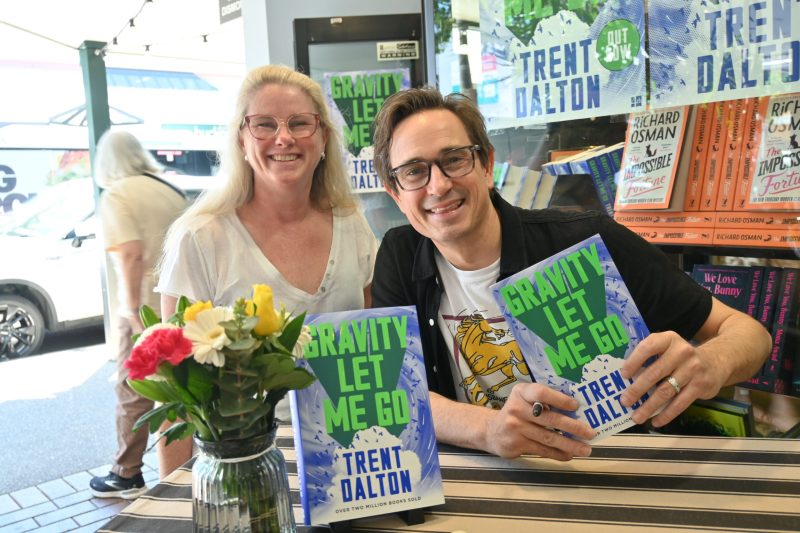
In his most recent book, Gravity Let Me Go, hot off the press from its release on September 30, the question of the floating cat becomes a symbol for long-term marriage.
“I was researching the moon, and how the moon cannot get away from earth even if it wanted to…
“I remember going to my letterbox, and imagining the neighbour’s cat across the street being lifted… into space.”
He imagined himself being lifted into space, too.
“At some point I write down in a notebook, gravity let me go.”
He asked himself, “What if that’s a metaphor for long term marriage?”
Balancing this surrealist hook is the unflinchingly real parts of himself and his life that Dalton pours into his books.
In Gravity Let Me Go, he asks through his protagonist, how far is too far, “when it’s too good of a story not to tell”?
“It’s all about this true crime journo who’s got the scoop of the lifetime at the expense of an even bigger scoop that’s unfolding inside his own home,” he said.
“This guy has gone too far, almost to the point where he’s putting his own family at risk.
“And you know, that’s me exploring the cost for my family of a guy who just devotes his life to storytelling… and unpacking parts of himself publicly.
“That’s a questionable activity, and my incredibly patient wife has had to deal with that.”
He said it is also “a tribute to hyperlocal journalism”.
“There’s this kid in that story named Clem, it’s his youngest daughter, and she starts up this thing called The Gecko Street Gazette.”
“…she realizes every single person in her street literally has a story that is worthy of a novel,” he said.
Perhaps Dalton’s real act of imagination is in the questions he asks of everyday people.