Published June 2025
They say the things you learn in childhood stay with you for life and that it is hard to break that early conditioning.
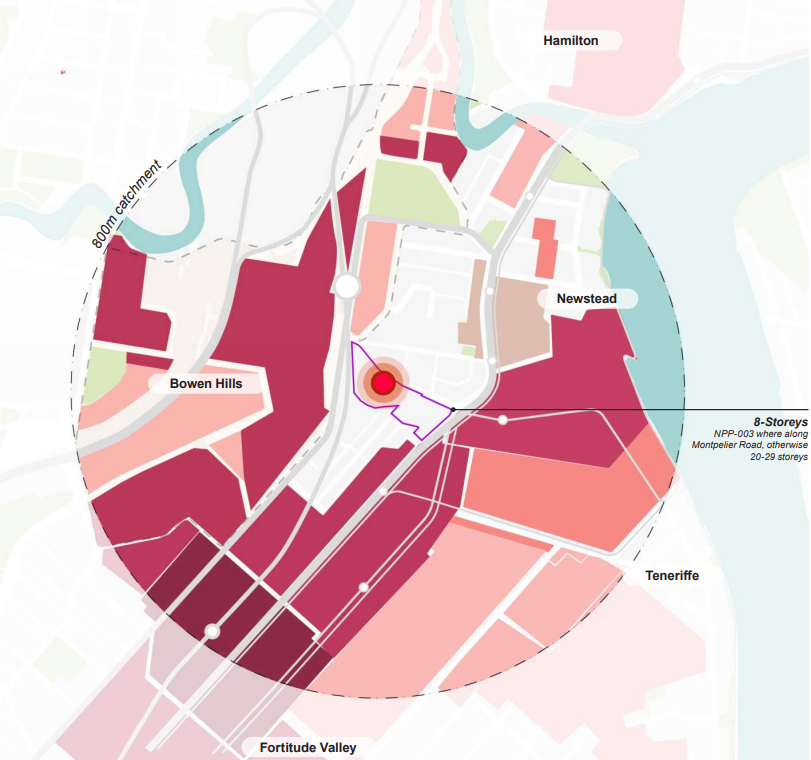
I thought that recently when I heard that Brisbane City Council is considering an approval to rezone the lower southern edge of Montpelier Rd to add up to five new towers comprising 1,500 units, in doing so, amending the neighbourhood plan.
Why would the Council be considering a scheme that demonstrates so little respect for the natural topography of the city, its historical context and for the local community?
I am reliably informed that Council does not have major objections to this scheme.
Perhaps the roots of this are historical.
Brisbane was formed as a penal colony, and it became viewed as a lesser city, without a belief it would one day be the important city it now is.
Perhaps we have never completely thrown off that beginning, causing us to welcome any project we believe gives us status.
There have been recent attempts to overcome this.
34 years ago, during the term of the Hawke/Keating Government, a federal government programme called Better Cities was instituted, designed to “renovate” Australia’s capital cities.
In Brisbane the results can be seen with the successful renovation of New Farm, and Teneriffe.
Keating, in a 2010 address to the Urban Development Institute of Australia, described the programme by saying:
“All the great cities have compactness and a geometry that facilitates the movement of people through them. And generally a geometry that has arisen over time through habit and convenience.”
The geometry and compactness in New Farm were driven by Trevor Reddacliff’s vision for Brisbane’s future, one that included density but did not include high rise residential.
However, that vision of the city is now at odds with the current focus on individual projects rather than those movement geometries that catalyse growth.
Some years ago, the Smart State Council commissioned a study by Michael Rayner that offered a comprehensive vision of Brisbane’s urban future.
Unfortunately, it ran foul of the council as they felt it was intruding into their territory.
Replacing that vision instead is the council’s increasing reliance on individual developments to promote change. Rayner asks in his Keeble lecture in 2019: “is that because of our inability to get out of a small town mentality?”
Without a vision the market itself decides the direction based on its own interests. Since Better Cities there has been comparatively little spent on the generation of urban development compared to infrastructure.
The arrival of the Olympics has given us the opportunity to reflect on what we are as a city and whether it is still possible to design a city that will serve us into the future.
We have heard about the iconic nature of Brisbane’s hills and rivers but the profound experience of Brisbane is by moving through it – experiencing those connections that Keating calls a facilitative geometry.
The process of transitioning through that geometry should be enjoyable, but instead many of Brisbane’s main traffic corridors are alienating places for pedestrians who must not only compete for space not only with cars but also large trucks and buses.
The older timber houses along these corridors must bear the nighttime sirens and the daytime roar of large trucks.
Perhaps in the context of market-led projects, it is easier to understand council support of a zoning change that will allow 30 storey towers in Montpelier Road that will not only block the view of Bowen Hill but also add significantly to road congestion that already exists.
This support is camouflaged by stating: “The proposal will unlock and facilitate delivery of substantial housing supply for the locality and inner-city Brisbane more broadly.”
High rise building typology does not resolve housing supply except for a select few, viewed instead as a measure of Brisbane’s status.
It is seen a marker that shows we are no longer an ex-penal colony.
But what it really says is we are more about symbols than we are about community.