When you think of a city what comes to mind?
Is it a single monument that identifies it? If someone asks you to describe Brisbane in a few words – what do you say? The Story Bridge? Southbank?
The awarding of the Olympic Games has turned some towards having one built – a legacy project.
Do we need one? Perhaps the city is its own monument?
There is a fascinating story about the Chicago World’s Fair in 1893 that followed Paris World’s Fair in 1889. The Paris World’s Fair Eiffel tower was widely celebrated throughout the world. Chicago was next up and a hunt for a structure as emblematic as the Eiffel Tower was launched.
The Fair’s Director of Works, Daniel Burnham, together with the organising engineers wanted a centrepiece to rival the Eiffel Tower. The intent was to find an American designer but there was a dearth of suitable ideas. It was even mooted that Eiffel himself could design something for Chicago as most of the proposals were considered too conventional, uninspiring, or unsafe. There was also much infighting as the fair was behind schedule – six months before opening nothing had been approved.
Does that sound familiar?
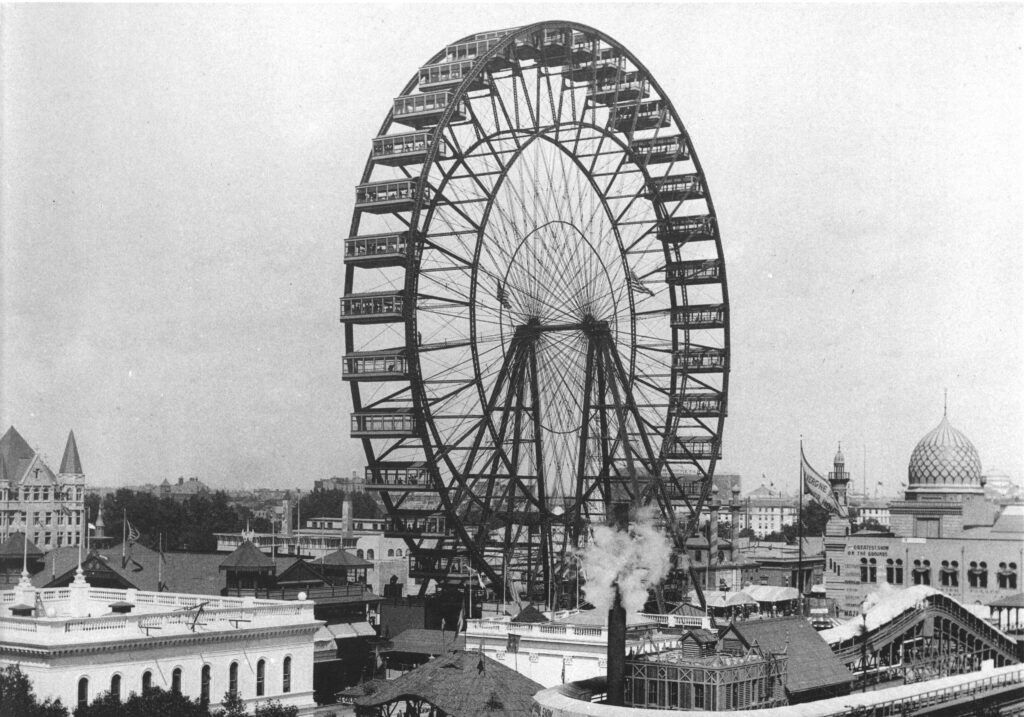
George Ferris, a 33-year-old bridge builder from Pittsburgh, presented an idea for a massive revolving steel wheel. It was initially rejected as unsafe and impractical, but after some lobbying and design revision (together with some financial backing), Ferris convinced them.
Its construction was an enormous success, but ironically its legacy is not attached to Chicago but instead it went to Ferris himself. The genius of its unique construction allowed it to be built all over the world.
Instead, Chicago became its own monument and the Fair itself shaped the look of American cities, demonstrating the value of comprehensive planning, coordination, and civic vision. The Fair also accelerated the adoption of electricity and embedded the Ferris Wheel in popular culture. It came to symbolise U.S. confidence into the 20th century. Its legacy was both inspirational and enduring.
What can we learn from this? Can we create an enduring monument catalysed by the Olympics? If we are thinking it might be a sports building or arena, well as we have seen with the Gabba, these buildings have a limited lifespan and have now developed a similarity in other parts of the world. Perhaps we look for something more profound that sums up who we are and ties itself to our local heritage and landscape?
In a recent discussion about the legacy of the Sydney Olympics, Lawrence Nield who was head of master planning for those games, remarked that the goal of Olympic master planning should be to create “a piece of the city, not just a sporting park”, pointing out that while many Olympic parks around the world inevitably fall into disuse, those that are well integrated into the urban fabric tend to thrive long after the games.
Chicago is an example of this working. Their Midway Gardens park was part of their World’s Fair masterplan and still functions as a public green space, with lawns, walkways, and sports fields, though its association with the World’s’s Fair remains its most famous chapter.
But whither Brisbane? In Brisbane’s case we must seize this opportunity given by the Games and create something that emboldens us, that rather than being just one element or monument.
It should, above all, be connected to the city and a public space for generations ahead to enjoy.