Published April 2025
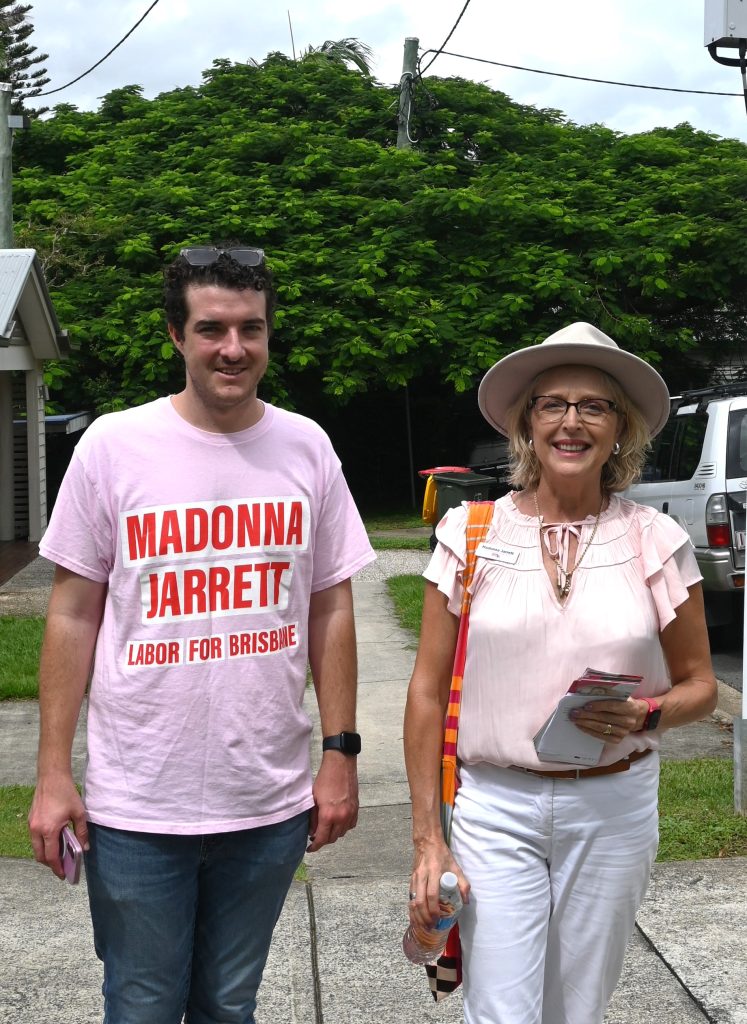
Spending the morning doorknocking in Windsor, Labor candidate for Brisbane Madonna Jarrett’s key message to residents is the vast difference between Labor and the LNP’s stances on health and energy.
We had first stopped in at Our Space for a coffee, a pottery studio and café in Wilston which Jarrett and her team had been helping to clean up from flooding last month, and there Jarrett shared some of Labor’s health plans.
She says health is one of the biggest issues coming up at people’s doorsteps, and people are really liking the announcement about the plans for nine out of 10 GP clinics to be bulk billing.
“Access to affordable healthcare affects every part of our population… we’ve heard young people saying they don’t go to the doctor because they can’t afford the gap fee.”
“All that does is push the cost down the road, and it could actually be a higher cost.”
The proposal of a free urgent care clinic for the inner city is also something they are getting good feedback on, Jarrett said.
“Who wants to go to hospital and wait for a long time? …They are a really good concept.”
She also talks about the women’s health package to counteract the ‘pink tax’ where women pay more in medical bills due to needing to go to the doctor more than men for reproductive health issues.
Labor plans to introduce new contraceptives and menopausal therapies to the Pharmaceutical Benefits Scheme, more Medicare support for menopause, and 11 new clinics for endometriosis and pelvic pain.
The topics of conversation on the doorsteps range from the expected – the cost of living, health, housing – to the niche, including electronic vehicles and the need to regulate Artificial Intelligence.
There is overall support for Labor but naturally also critiques of what people would like to see more of from the current government.
Jarrett’s response to many of the suggestions from people she talks to is proactive – a promise to look into it further and take it back to the party for discussion.
She says their HECS reductions are increasing affordability for young people, especially their ability to get loans for house purchases.
“We’re talking about the HECS reductions that the government has done in terms of the interest rate and then the 20% reduction that will come should the government be re-elected.”
They are also introducing a help-to-buy scheme where the government co-invests in the house purchase meaning a smaller down payment, which Jarrett says removes the major problem of having enough equity for the purchase.
With inflation underpinning the cost-of-living crisis, she says Treasurer Jim Chalmers has been putting in place levers to counteract that – with inflation having fallen from 7.8 per cent in December 2022 to 2.4 per cent most recently.
Her other key message on the doors is the prospect of renewables versus nuclear energy, which is what Opposition Leader Peter Dutton has proposed as the solution to Australia’s energy needs.
In a discussion with a resident, Jarrett notes: “The government is not just introducing renewables for the sake of it; it’s about our whole industrial policy, where our country is going to be going, where new skills are being developed.”
After a hot morning doorknocking, Jarrett switches gears for an announcement in Lutwyche with Assistant Minister for Mental Health Emma McBride.
They meet with Communify CEO Karen Dare and Brisbane North PHN CEO Libby Dunstan to discuss the new Medicare mental health centre opening on Lutwyche Road in July.
Free mental health support and care will be available for walk-in appointments, not requiring a referral.
“We know that at least 20 per cent of our population suffer a mental illness or disorder or need medication, and these sorts of services, which will be clinical and non-clinical, will be so needed in our community,” Jarrett says.
For Jarrett, who has a background in health and equity policy making, the election will come down to whether people choose renewable energy, support for equitable health policy and continued “responsible” action on inflation.