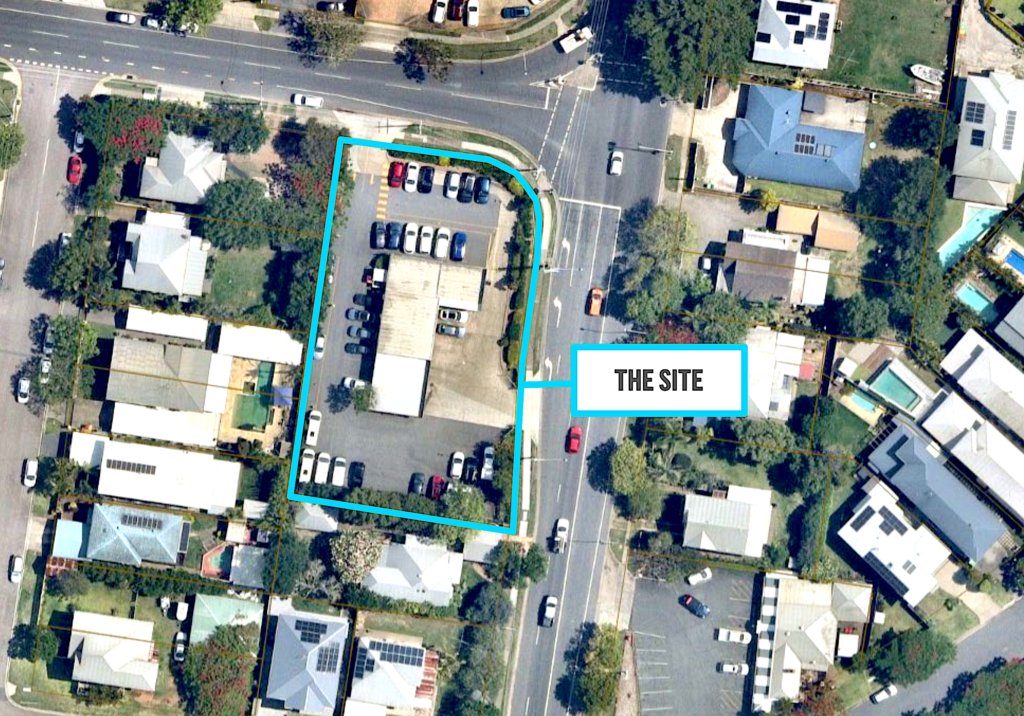
Hendra residents have lodged a Right to Information (RTI) request for environmental decontamination records relating to a proposed McDonald’s drive-through restaurant at 330 Nudgee Road.
Bill Moore has submitted RTIs to both the Council and Environment Department.
“Transparency is the only way to restore public trust,” he said.
“Locals deserve to have confidence that the Council has done the right thing by us and taken the appropriate steps to ensure safety.
“At this point in time, there’s a question mark as to whether or not that has taken place.”
The development application (A006543699) in a residential zone was approved by Brisbane City Council in January 2025. It attracted 436 public submissions, of which only nine supported the proposal.
The dispute centres on the site’s previous use as a 1960s-era service station. Records state the land was remediated and removed from the State Government’s Contaminated Land Register and Environmental Management Register in 1999.
Remediation work predates the 2013 updates to the National Environment Protection (Assessment of Site Contamination) Measure, which introduced stricter requirements for assessing petrol hydrocarbons and vapour intrusion pathways on sites with a history of notifiable activities such as fuel storage.
A Brisbane City Council spokesperson said that planners did not review site-specific environmental reports during assessment.
“Our assessment follows state government’s rules, so it is only referred to them and independent testing is only done if those rules require it,” the spokesperson said.
The application avoided further scrutiny by the State Assessment and Referral Agency after the project’s town planner, Urbis, assessed provision AO11 — the code for excavation on land previously used for high-risk activities such as fuel storage — as not applicable.
McDonald’s Australia did not respond to Village Voice requests to see copies of the 1999 remediation certificates or more recent soil or groundwater testing data the company has previously said it possesses.
Technical reports submitted with the development application state the proposed works will increase ground permeability by approximately 10 per cent. Three groundwater monitoring wells, installed to track potential chemical residues, remain on site near the mechanics workshop that still operates.
Neighbours have expressed concern that greater water infiltration could mobilise residual contaminants — such as petrol hydrocarbons, PFAS or oils — into surrounding groundwater.
Mridula Mantravardi and Shreyas Boppana, who will live next door to the McDonald’s with their six-month-old daughter, described the development as a threat to their quality of life.
“I remember endless sleepless nights… picturing our daughter growing up next to a 24/7 fast-food restaurant,” Ms Mantravardi said.
“Our backyard, once a sanctuary, now feels like it will be a battleground against noise, pollution, litter and the constant invasion of our privacy.”
Matthew Petrusma and Denise Garcia pointed to what they see as an inconsistency in planning rules. “As residents we are governed by strict character home regulations, yet the council is allowing a fast-food chain to be built next to our homes,” Mr Petrusma said.
Hendra Locals Against McDonald’s launched a Planning and Environment Court appeal and raised more than $30,000 for its war chest. The group withdrew the case after exhausting legal funds.
In a statement to Village Voice, McDonald’s Australia said it was “excited to be joining the Hendra community. McDonald’s has been a part of Brisbane communities for 50 years, employing thousands of people, serving up a locally sourced menu and providing convenient destinations for customers looking for great everyday value and those iconic Macca’s moments.”