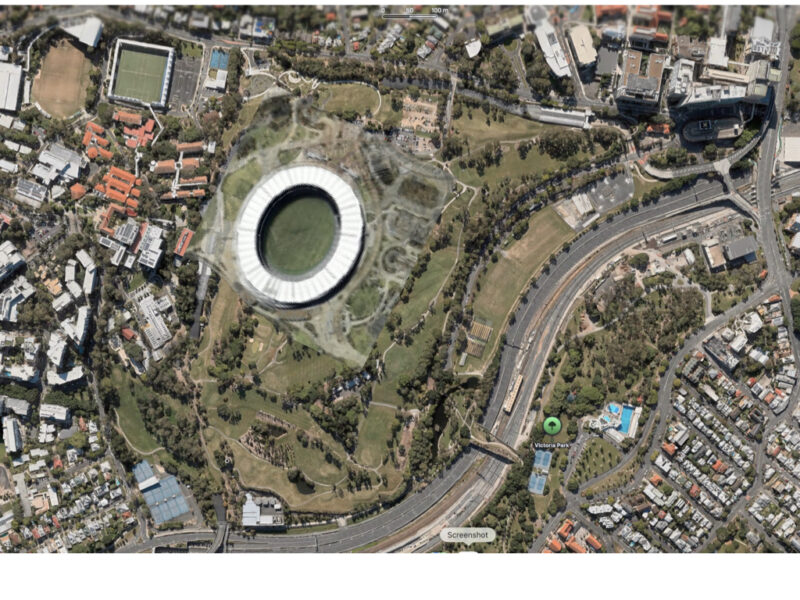
Is it now time to say goodbye to Victoria Park?
For 150 years Victoria Park has survived rail lines, hospitals, war huts and roadways. Now it faces its greatest transformation yet — an Olympic stadium.
The park, named after Queen Victoria, covers an area of 64 hectares of land connecting Herston and Bowen Hills and has been gazetted as public land since 1875.
Before European settlement, it was known as Barrambin and supported Aboriginal settlements while also being a cultural gathering place for local tribes.
There was initial coexistence between the European settlers and the Aboriginals, but with the expansion of the Brisbane settlement, conflict with the local Turbal people developed into full scale hostilities with killing of Aboriginal leaders and burning of Aboriginal campsites by the settlers.
By the end of the 1860s most Aboriginal people had either been removed from, or had left, Victoria Park.
In the 19th Century parks became viewed as essential open spaces, being referred to as the “lungs of the city” since there was a belief that diseases were transmitted through the air – the miasma theory. As a result, a Board of Trustees was established to manage and protect Victoria Park.
Yet the Park has rarely been left untouched.
Since the 1880s it has been steadily reduced and reshaped. A railway line to Sandgate cut through it in 1882. A Hospital for Sick Children followed in 1883. School sporting grounds occupied the south-west. Electrical infrastructure and substations took land at the Bowen Bridge end. The Victoria Park Golf Club was established in 1926.
During the Second World War, US military huts were constructed across parts of the park. After the war those huts temporarily housed Australian war brides and, later, local families during a housing crisis — at one point accommodating 450 families under Queensland Housing Commission management. University and medical research facilities occupied former military buildings before eventually relocating.
Further incursions followed: the Centenary Pool complex in 1959; departmental office buildings; and, in 2003, the Inner City Bypass constructed alongside the railway corridor.
For nearly 150 years Victoria Park has adapted to the city’s pressures while still remaining public land and now it faces its most significant transformation.
Cities have long used major events to catalyse their growth. Brisbane’s 1982 Commonwealth Games strengthened civic confidence. That was followed by Expo ’88 which reshaped South Bank that gave a strong sense of achievement to the city.
For a while it seemed Victoria Park was safe from any future major developments. In 2020 the Council released a document called Victoria Park Vision after extensive consultation with local and Aboriginal communities. That document promoted environmental restoration of the park while enhancing visitor experience.
In 2024 David Crisafulli, rejecting the Quirk recommendation of a stadium built in Victoria Park, pledged, if elected, not to build any new stadiums and that he would appoint an independent infrastructure authority to review Games infrastructure.
So much for promises – for the first time in its history, its protected status is being altered. The removal of state protection and conversion of the land to freehold represents a structural shift in how this space is governed.
What does that mean for its future?
If a stadium is built here, what enduring protections will guarantee that Victoria Park remains a genuine public landscape beyond the Games? Who will determine the stadium’s exact siting — and from what criteria? Is it cost efficiency or long-term civic value? Can open space lost during construction be meaningfully restored or enhanced? These are not arguments against hosting the Olympics. Nor are they arguments against investment in city-shaping infrastructure. They are questions about legacy.
Perhaps Victoria Park, after technical and planning analysis, is the only viable location, and if that is the case, the obligation to protect its broader public purpose becomes even greater. The design, governance and legal framework must ensure that the park’s identity as a civic landscape is strengthened, not reduced.
Brisbane has inherited Victoria Park through layered histories — Indigenous occupation, colonial violence, Victorian public health ideals, wartime adaptation, post-war housing pressures and late-20th-Century infrastructure expansion – and it has endured as an open, shared space.
Olympic stadiums serve a moment in time, while parks serve generations, and it is important to ensure that Victoria Park is remembered and still enjoyed as a place where civic responsibilities have matched civic aspirations.