

There has been much talk recently about the housing crisis – about high rents and the high values of houses and apartments making it difficult for younger people to enter the market.
Governments signal they are solving the housing crisis by waving through high rise development schemes. But are they really solving it?
Housing supply is not just an Australian problem; it is also happening in other countries. But when it occurs in Australia, context is ignored and blame is spread – immigration is blamed as a major contributor.
The reality is more complex – there are things governments can do, but their limits are constrained because governments do not have control of all the pieces.
It is called a housing market so things like lending practices, availability of land, zoning regulations and construction productivity all play a part, and while they can be influenced by government policy, they cannot be completely controlled.
It will take time to fix our housing problem. It appears, however, that New Zealand is doing something we could follow.
One key contributor to housing supply is planning, and in particular zoning. Another is the productivity of the building industry.
A recent paper by Matthew Maltman of the e61 Institute compares the Australia and NZ building economies.
Because it has fewer layers of government, NZ was able to successfully introduce zoning reform and between 2013 and 2017 implemented planning codes allowing three-storey medium-density development across cities (the missing middle), with high densities confined to transit corridors.
This influenced residential construction by increasing the size of residential building businesses which were doing the work, while also increasing competition because of an improvement in the economics of building larger scale residential buildings.
NZ also allowed workers to opt out of collective bargaining agreements, freeing up the labour market.
In turn that competition increased building productivity by 20 per cent between 2000 and 2020.
Housing productivity directly affects supply and demand. We saw this in Australia where a recent 18 per cent reduction equated to an 18 per cent increase in costs.
Australia is constrained by its multi-level system of government with federal state and local governments often with competing policies.
State governments, along with town and city councils, operate directly with their communities and are thus susceptible to community pressure.
There has been pushback to increased density in many Australian cities, with local and state governments reluctant to fully address this, fearful of their electoral chances.
Immigration is seen as a contributor; however, in 2023-2024 year the largest group – nearly half of the 446,000 immigrants – were students on temporary visas. They need to be housed, but they also bring an enormous amount of money into our education economy. Is it likely that those 200,000 temporary residents are seeking single family homes in the suburbs? I don’t think so.
So how to fix the issue?
Is it by pursuing the suburban house model? A model that consumes an enormous amount of infrastructure – and land – before the first dwelling is built. A model that is highly reliant on the motor car.
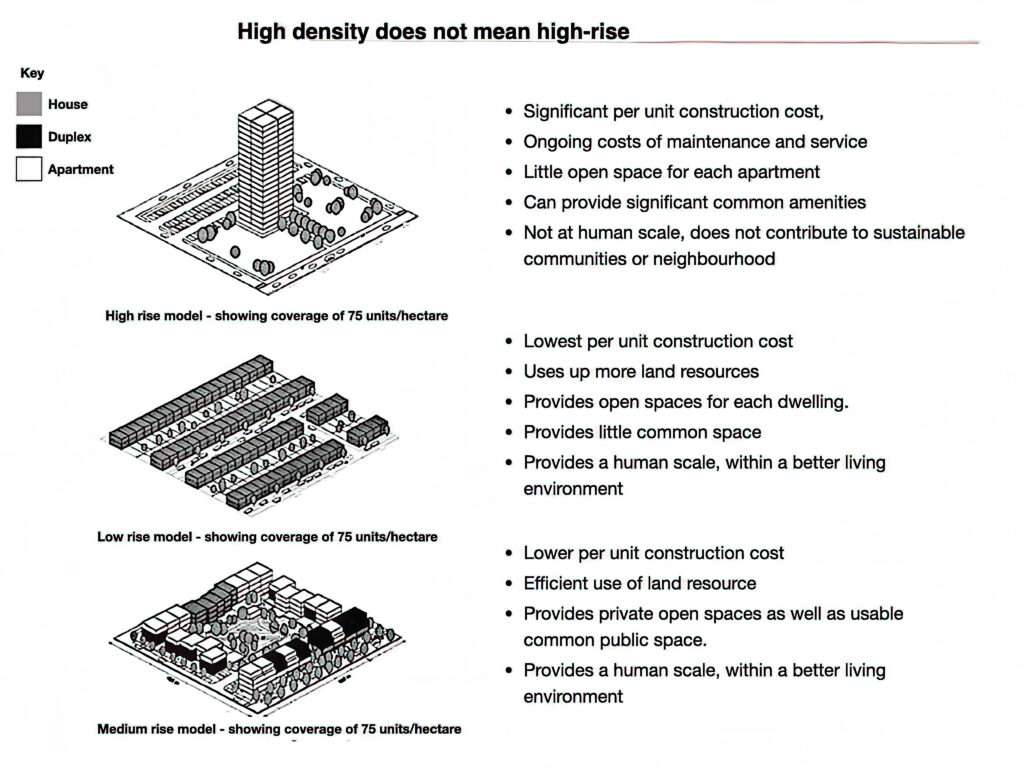
Is it just by building high rises? While this model is often seen as an easy fix, high rises may create longer term problems.
In a recent article, English psychologist Ian Leslie talks about communities’ “strong ties” and “weak ties” – inner and outer social circles.
Strong ties are the people you know well – family and close friends. Weak ties are acquaintances – familiar faces in the neighbourhood, in shops, cafés, pubs, or the gym – but these are ties that are important for our mental health, giving us stimulation and a sense of community, of belonging.
High rises, with their exclusive facilities, allow people to remove themselves from their communities, and this is exacerbated by a delivery economy where stuff is brought to you.
Community interactions have also shifted online, with online groups organised around affinities and beliefs, reinforcing isolation.
Perhaps the model that shows the most potential, the healthiest, is the one being explored in NZ: the “missing middle”.
With its lower scale, five storeys or less, it can provide density without isolation.
You get to know your neighbours because they are close. And in addition, it is a model that has served communities throughout the world for centuries. We need to try it here.
Do you think medium density can solve our housing issues?
Have your say – email [email protected]