Published July 2025
I love examining old pre-World War II maps of Brisbane. When looking at them I try to imagine life before that war: a small town emerging from the Great Depression with war clouds developing in Europe but Brisbane’s best years in front of it.
I was looking at a map from the 1920s recently – the Brisbane River scything through the city segregating the north from the south with only one road river crossing, the Victoria Bridge, built in the 19th Century. An enormous divide between north and south Brisbane.
Not only road – the rail connection from the south into the city was through a rail bridge at Indooroopilly built in the 19th century. The Merivale Bridge linking rail between Roma St and South Bank wouldn’t come until 1978.
In the 20th century more connections were planned. There was agitation for a bridge across Kangaroo Point in the late 19th Century and considered again in 1926 although Brisbane’s then sectarian culture together with costs delayed its planning in favour of a bridge at Grey St, (now the William Jolly Bridge) which was completed in 1932. The new State Labor Government initiated several Government sponsored employment generating projects, the new bridge being one of these (The others being the Stanley River Dam and the UQ Campus.) The new bridge did have a benefit over the others – the opportunity to reduce capital expenditure by charging tolls.
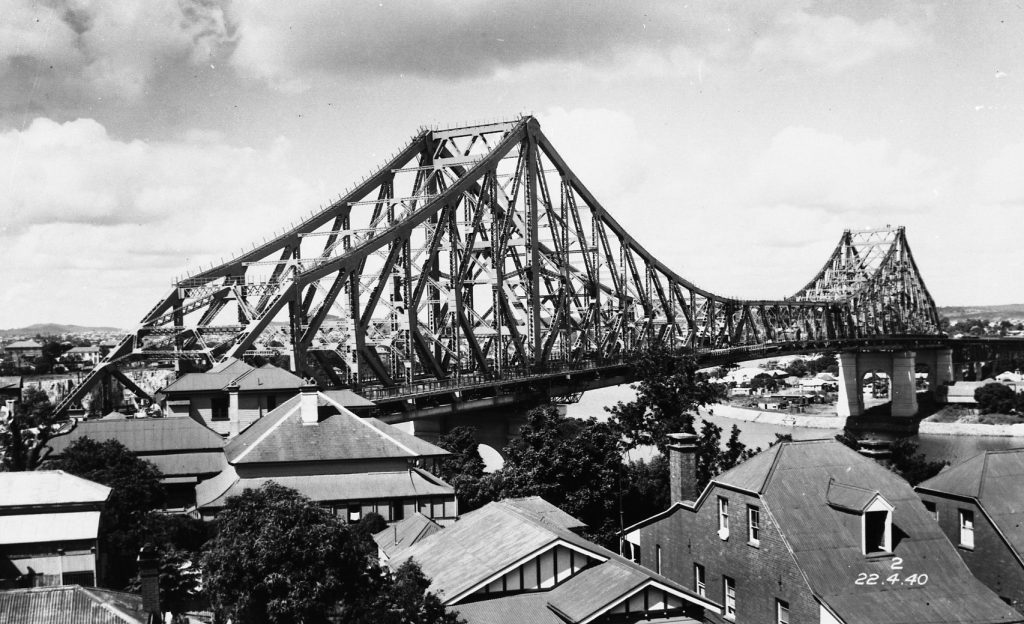
Planning began in 1933, and it was an all-Australian effort, designed by a Queensland born engineer Dr JCC Bradfield, (who also directed the design of the Sydney Harbour Bridge) and built by Queenslanders, the contractors Evans, Deakin & Co. Ltd and Hornibrook Constructions Pty Ltd.
It was a major engineering and construction accomplishment, and it is still today the largest span metal truss bridge in Australia with a main span of 281.7 metres, its economical design removing the need for a central pier to allow shipping to the wharves in the CBD.
The new bridge mirrored Bradfield’s design process on the Sydney Harbour Bridge: both were “rough copies” of bridges elsewhere, for the Sydney Harbour Bridge, the Hells Gate Bridge in New York and the Brisbane bridge closely resembling the Jacques Cartier Bridge in Montreal, Canada.
Until it was completed, the bridge was known as the Jubilee Bridge in honour of King George V. After it was completed in 1940 during the Second World War, it was named after public servant John Story who had advocated strongly for the bridge’s construction. The bridge was initially regarded as a white elephant with the toll unpopular and little traffic usage. Still, the cost was recuperated in seven years and ownership and maintenance was passed to the Brisbane City Council in 1947, with toll charges abolished that same year.
The most extraordinary thing of all is that 85 years ago it was approved and built far larger than the traffic of the day required. Six lanes! And It still carries nearly 100,000 vehicles a day.
So why is it now failing? Simply because it is getting to the end of its life – the timespan it was designed for was 100 years, an eternity in the post-depression and early war years and while the materials selected were the best available then and regular maintenance has been performed it has deteriorated.
The Council has acted quickly to commission a study headed by Nigel Chamier that will prepare a business case for how the bridge can be remediated to assure its future. The bridge’s structure is metal truss comprised of 1.25 million bolted and welded connections that will need to be checked and if necessary, replaced. While it is now possible to use technology to examine the viability of its structure, the labour costs repairing it will be very high.
Not only is it an iconic structure that generations of Queenslanders have loved, it has played a transformational urban design role in the city connecting its north and south. It is a bridge for all Queensland, a major historical marker, representing a significant moment in Brisbane’s development and has been a cherished element in our landscape. It must be preserved.