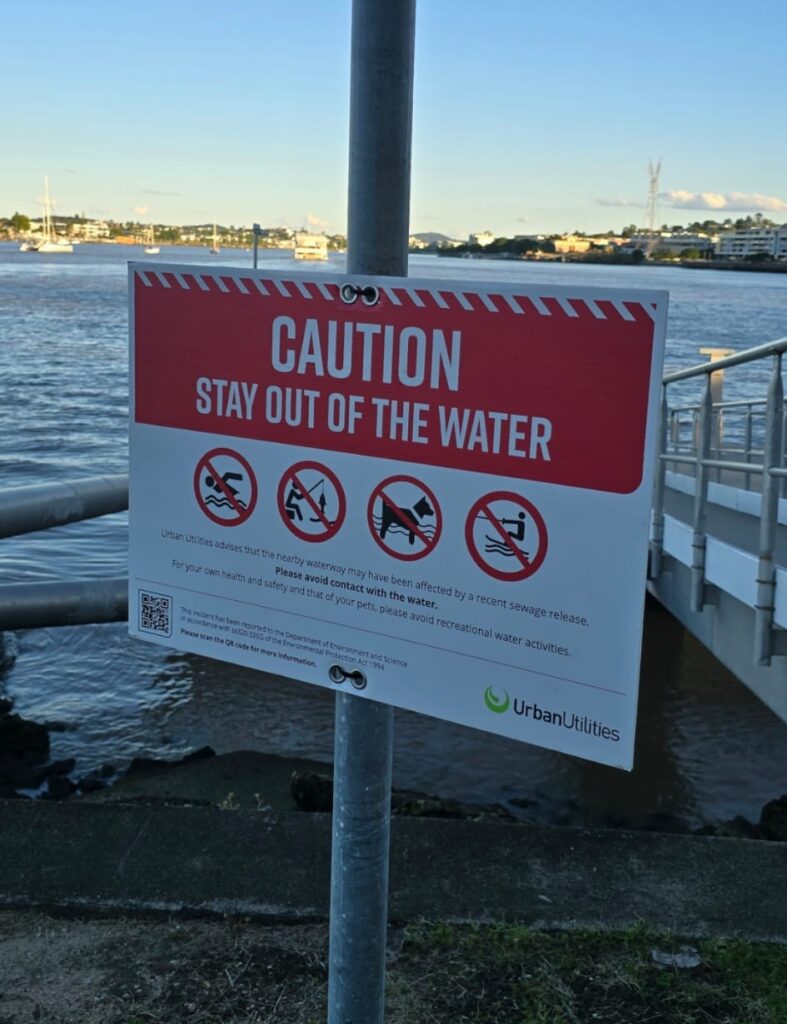
A Right to Information (RTI) request filed last year could finally reveal the full extent of sewage discharges into Brisbane’s rivers and creeks between Hamilton and Bulimba.
The RTI, filed by Adam Bowden, founder of Stop Raw Sewage into SEQ Waterways, was originally due on December 4 at 5.30pm. Five minutes before the deadline, the department requested an extension, which pushed the date to January 28. A second extension has now been granted for March 18.
Father-of-two Bowden said the RTI involves more than 1,800 pages of documents.
“That’s massive,” he said. “It shows just how much information sits behind what’s going into our rivers and creeks.”
Urban Utilities conducted wet-weather sewage releases under environmental permits issued by the Department of Environment, Tourism, Science and Innovation.
“There are so many reasons to fix this, and the government has the power to act — yet it chooses not to,” Bowden said. “We call ourselves the River City, but our waterways are struggling; this will be a terrible look for the 2032 Olympics.”
The sewage releases are linked to the $210 million Bulimba-Hamilton Siphon Renewal Program, which was tasked in 2023 with upgrading key infrastructure built between 1948 and 1954 to carry sewage and wastewater from Brisbane’s south side to the Luggage Point sewage treatment plant.
Unlike standard sewerage pipes, the siphon uses two U-shaped pipes running about 60 metres beneath the Brisbane River. Wastewater flows from higher ground at Bulimba to Hamilton using gravity alone.
In January 2024, a structural failure in one of the two pipes caused sewage to flood the access tunnel. With only one pipe operational, wet-weather overflows of sewage and stormwater were released into the river at Morningside to prevent sewage backing up into homes and streets in surrounding suburbs. Over the subsequent 18 months, controlled releases totalled an estimated 540 megalitres — equivalent to roughly 216 Olympic-sized swimming pools.
Urban Utilities installed a temporary bypass, but the system remains vulnerable to storm overflows while the siphon is offline for inspection and repairs.
The sewage releases are expected to continue for several years as repairs and the renewal program progress.
Enterococci bacteria, which can cause gastrointestinal and skin infections, have repeatedly exceeded safe recreational thresholds locally following rainfall.
Urban Utilities said releases have been monitored, reported, and accompanied by public warning signage at Vic Lucas Park and the Colmslie Reserve as well as on the northern side of the river at Hamilton’s Northshore Riverside Park and Newstead House pontoon. Urban Utilities urged residents to follow official guidance and seek medical advice if exposed.
Brisbane City Council said it worked with other local governments through the Resilient Rivers initiative, conducts additional water testing during warmer months, and issues public advice following rainfall events.
When the RTI documents are released, Bowden believes they will finally quantify the true scale of the sewage problem and prompt a broader public reckoning.
“The bacteria in the water can enter wounds. I’ve heard of kids who cut their feet and ended up in hospital, and residents who became sick for days after water splashed on their faces,” Bowden said.
“We need a better notification system for public safety; that’s the most immediate fix right now for community safety.
“Better monitoring, better signage, and urgent infrastructure upgrades are not optional.”
• These concerns are backed by the 2025 Healthy Land and Water Report Card, which assesses the Lower Brisbane catchment as remaining in “poor” condition.
The data reveals a river system under extreme stress: estuarine water quality has declined, and nitrogen and phosphorous loads remain “very high”.
Freshwater stream health improved from very poor to poor. Pollutant loads increased from low to very high, with sediment loads rising from 225 kg/ha in 2023 to 875.1 kg/ha in 2025, nitrogen loads at 8.6 kg/ha (rated high), and phosphorus loads at 2.8 kg/ha (rated very high).
Estuarine water quality declined from fair to poor. Nutrients (total nitrogen and phosphorus) remained in very poor condition. A 15-year upward trend in total nitrogen and algae (chlorophyll a) is evident in the estuary.
Freshwater wetland extent remains very poor, with 25% of historical extent remaining. Estuarine wetland extent (mangroves and salt marshes) remains poor, with 40% remaining in the catchment.
Riparian habitats in freshwater reaches remain in poor condition, with 368 hectares of riparian woody vegetation lost between 2018 and 2023 and minimal regrowth recorded.
Freshwater fish and macro-invertebrates remained in very poor condition. The estuarine fish community in the Lower Brisbane estuary is in very poor condition.
The Report Card, which is now released biennially, paints a picture of a river system already under extreme pressure — and yet the river continues to be exposed to ongoing sewage discharges.